The Human Layer of Artificial Intelligence
Artificial intelligence (AI) and machine learning (ML) are quickly becoming a new layer in network operations. Across the broadband industry, operators are exploring AI to manage increasingly complex infrastructure, analyze large volumes of telemetry, and accelerate the diagnosis of network issues. The promise is compelling. AI systems can sift through data far faster than humans, identify patterns that may be difficult to detect manually, and assist with tasks that previously required years of operational experience.
Yet as organizations rush to deploy these technologies, an important question emerges: What knowledge are these systems actually learning?
Modern networks are built and operated through layers of technology, from the physical infrastructure that carries signals to the software systems that monitor and control network behavior. But there is another layer that often receives far less attention when AI systems are introduced into operations. That layer is the human layer: the collective experience, reasoning, and judgment developed over years of working with real networks.
Much of the knowledge that keeps networks running does not exist in standards documents or technical papers. It lives in the insights of experienced practitioners who have learned, through observation, troubleshooting and failure, how networks behave under real-world conditions. These individuals understand how to interpret telemetry, recognize subtle signs of impairment, and reason through complex interactions between systems.
When AI is introduced into network operations without capturing this human layer, organizations risk building systems that can process enormous amounts of data but lack the operational context needed to interpret it correctly.

One reason this risk is often overlooked is the assumption that technical documentation provides a complete picture of how networks function. In reality, there is an important distinction between technical knowledge and operational knowledge.
- Technical knowledge describes how systems are designed to operate. It includes standards, specifications, and architectural principles. These resources explain how protocols behave, what parameters should look like under normal conditions, and how components interact within an idealized environment.
- Operational knowledge reflects how systems behave in the field. Networks exist in environments influenced by weather, aging infrastructure, vendor implementation differences, and countless other variables. Practitioners who spend years diagnosing real network problems develop a mental library of patterns and correlations that rarely appear in documentation.
A specification might describe expected signal levels or modulation characteristics, but someone with operational experience may recognize patterns in telemetry that consistently precede certain impairments or faults. These insights are rarely documented formally. They are developed through repeated exposure to real incidents and shared informally through collaboration and mentorship.
Artificial intelligence systems trained only on specifications and technical documentation may understand the theory of a network but struggle to interpret the reality of its behavior. Bridging that gap requires capturing the reasoning processes used by experienced practitioners when diagnosing and resolving issues.
Another challenge arises from how AI systems are trained. Machine learning models learn from the data and context provided to them. When the information used to train these systems lacks deep domain expertise, the models may identify patterns that appear statistically meaningful but are operationally misleading.
An analogy can be seen in generative AI systems trained on the open Internet. While the Internet contains useful information, it also contains inaccuracies, conflicting explanations, poorly reasoned conclusions and meanings that diverge from their true definitions. When models ingest uncurated data, the result is often an increase in noise: outputs that sound authoritative while containing subtle but consequential errors.
What if AI systems are trained primarily on telemetry and documentation without incorporating operational experience? Instead of capturing expertise, the system will amplify misunderstandings or incomplete assumptions.
This highlights an important reality of AI deployment: The individuals best equipped to ensure that AI systems learn the right lessons are those who understand the network in practice. Experienced specialists, technicians, and operations professionals must play a central role in shaping and validating AI systems if those systems are to become reliable tools.
Their involvement is essential in defining meaningful training data, explaining how telemetry should and should not be interpreted, and identifying when an AI system reaches conclusions that appear plausible but do not align with real network behavior.
This work can place additional demands on the most knowledgeable individuals within an organization. However, it also presents an opportunity. The process of training and validating AI systems forces operational reasoning to be articulated in ways that may never have been documented before.
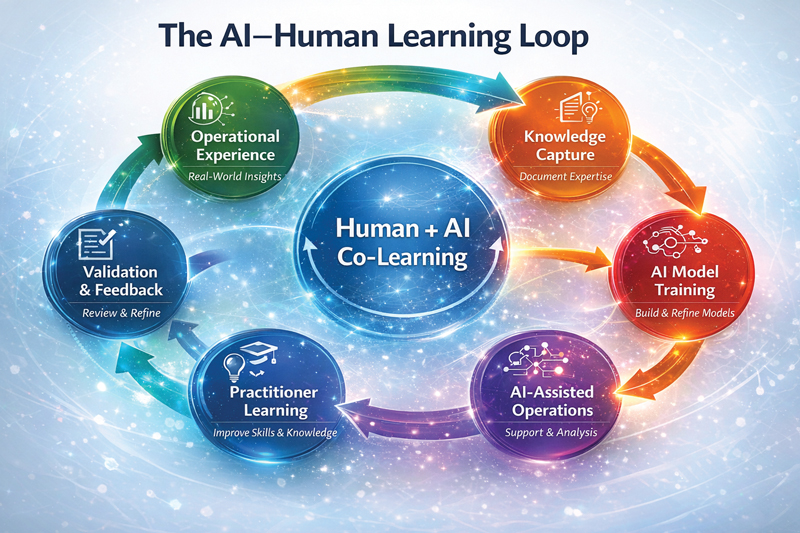
When practitioners explain how they approach troubleshooting, interpret telemetry patterns, and narrow down possible causes of faults, that reasoning can be captured as part of the organization’s institutional knowledge. Over time, these insights can be incorporated into diagnostic workflows, causal models, and operational playbooks.
AI deployments should therefore become more than automation initiatives. They should become catalysts for improving both institutional knowledge and workforce development.
The knowledge captured while training AI systems can also be used to train the people who will work alongside those systems. By documenting troubleshooting logic, historical incidents, and interpretation guidelines, organizations can enhance training for newer practitioners and help them develop deeper and faster operational understanding.
Those same individuals must then contribute to the continued training and validation of the AI system itself. In this model, human learning and machine learning reinforce one another. The system captures expertise, distributes it more broadly, and enables more practitioners to participate meaningfully in refining the model.
For this approach to succeed, however, organizations must also address an important challenge: controlling noise in the knowledge used to train AI systems.

Not all insights contribute equally to reliable operational understanding. It is easy to misinterpret telemetry, draw incorrect conclusions, or overestimate familiarity with network behavior. If flawed interpretations are incorporated into training datasets, they will degrade the quality of the model’s reasoning.
Maintaining high-quality training data therefore requires mechanisms for validation and oversight. Contributions to training datasets should be reviewed by experienced practitioners, and AI outputs should be continuously evaluated against real operational outcomes. Structured incident reviews, peer validation, and curated knowledge repositories can help ensure that the expertise captured reflects reliable operational understanding rather than speculation and noise.
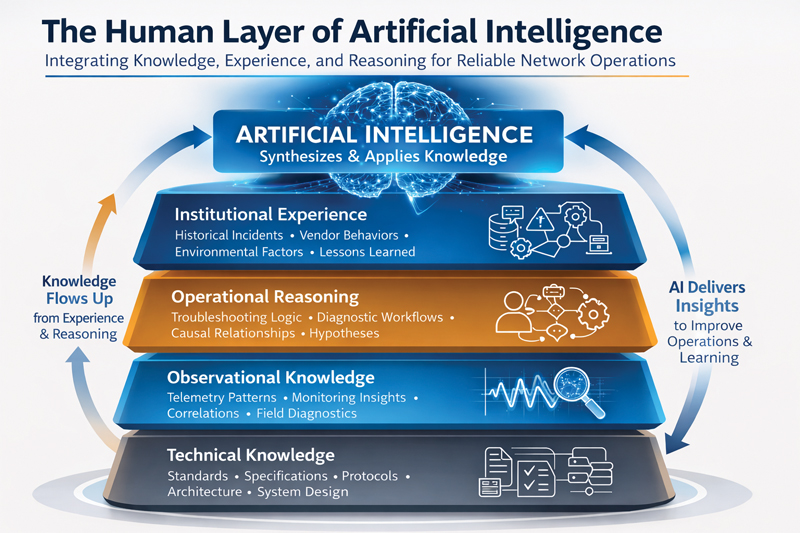
A useful way to think about this is to consider the types of knowledge AI systems must integrate.
- The first layer is technical knowledge: the standards and architectural principles that define how networks are designed to operate.
- The second layer is observational knowledge: the patterns visible in telemetry and diagnostic tools.
- The third layer is operational reasoning: the process practitioners use to interpret observations, develop hypotheses, and diagnose faults.
- The final layer is institutional experience: historical knowledge about recurring issues, vendor behaviors, environmental factors, and past incidents.
AI systems that incorporate all of these layers can evolve into something more than analytical tools. They will become repositories of institutional memory, helping organizations preserve and distribute operational knowledge across teams and generations of practitioners.
Artificial intelligence will undoubtedly become an essential part of network operations. But the success of these systems will depend not only on algorithms and data, but on the knowledge embedded within them.
The most valuable asset in network operations remains the experience and reasoning of the people who understand how networks actually behave. If AI deployments capture and preserve this human layer, they can strengthen organizations and accelerate learning across the workforce.
If they do not, operators risk building automated systems that can act but no longer understand.
 Allen Maharaj
Images provided by Author (Generated using AI tools), Shutterstock.