Big Numbers, Small Numbers
Ours is a world of numbers, and in cable we use a lot of really big and really small numbers. Dealing with very large and small numbers can, perhaps unsurprisingly, be cumbersome. Fortunately, there are several ways to simplify how we describe and use those numbers.
In reality, it’s hard to grasp just how big or small numbers can be. Consider the number 1,000,000. When discussing a radio frequency (RF) signal, 1,000,000 might be the signal’s frequency, as in 1,000,000 hertz (Hz). It also might represent a data rate, say, 1,000,000 bits per second (bps).
How big is 1,000,000?
If you were to count to 1,000,000, how long would it take? Assuming one second per number, and counting nonstop (no sleeping, eating, drinking, or …) to 1,000,000, it will take a million seconds. That’s just over 11-1/2 days. From that perspective, a million is a pretty big number.
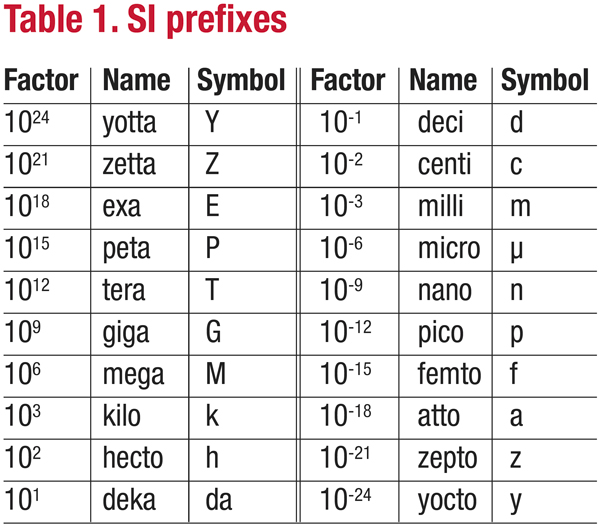
It can be inconvenient to deal with large numbers like that (the same is true of small numbers), which is where the International System of Units (SI)—specifically SI units and prefixes (http://physics.nist.gov/cuu/Units/prefixes.html) help. Using the SI prefix mega (symbol M), our earlier 1,000,000 Hz frequency becomes 1 megahertz (1 MHz), and 1,000,000 bits per second becomes 1 megabit per second (1 Mbps). Table 1 summarizes common SI prefixes. Care should be taken to ensure that the correct upper- or lowercase for both name and symbol is used. For example, contrast the SI prefix mega (symbol M) with the SI prefix milli (symbol m): same letter of the alphabet for the symbol, but different cases and completely different meanings. A lowercase k is the symbol used for kilo, while uppercase K is for kelvin. Note: kelvin (symbol K, no degree sign) is the SI base unit for thermodynamic temperature; the “k” in kelvin should be lowercase, too.
Pop quiz time
Which is correct: “the data rate is 3 Gigabits per second” or “the data rate is 3 gigabits per second”? The correct answer is “the data rate is 3 gigabits per second” (3 Gbps). An important point: Per the SI, there should be a space between the number and abbreviation.
Signal level: Really small numbers
Have you ever wondered why we use the decibel (dB) to express signal level? Why not just use the signal’s actual voltage in units of volts or power in units of watts? One big reason is the very small numbers that make up typical cable network RF signal levels. Think about the minimum input to a subscriber terminal for analog NTSC TV channels, as defined in Part 76 of the FCC’s Rules: 1 millivolt (in a 75 ohms impedance), or 0.001 volt.
That 0.001 volt isn’t too cumbersome as far as the number of zeros to the right of the decimal point, but the same signal level expressed as power, which works out to 0.00000001333 watt, or 13.33 nanowatts (nW), is arguably much more unwieldy. Consider that a line extender amplifier’s typical per-channel RF input signal level is 0.010 volt (10 millivolts) or 0.000001333 watt (1.33 microwatt, µW), and its per-channel output signal level at the upper end of the downstream spectrum is, say, 0.251189 volt (251.189 mV), or 0.000841276 watt (841.276 microwatts, µW). Can you imagine dealing with numbers like those on a daily basis?
The decibel allows us to express those same signal levels as 0 dBmV, +20 dBmV and +48 dBmV respectively, using the formula dBmV = 20log10(signal level in millivolts/1 millivolt).
Speed of light: A really big number
One measure that we deal with from time to time is the speed of light, designated c0 in a vacuum and c in other media. According to the National Institute of Standards and Technology, the speed of light in a vacuum is 299,792,458 meters per second. In other common units, that works out to 983,571,056.43 feet per second, 186,282.397 miles per second, and 670,616,629.39 miles per hour. That’s really, really fast! How fast?
Imagine a beam of light that could somehow travel unimpeded around the Earth’s equator.
For this example, I’m ignoring the fact that light typically travels in a straight line (there are some unusual exceptions), terrain obstructions, reflection, atmospheric refraction, and the atmosphere’s slightly different velocity of propagation compared to a vacuum.
In 1 second our hypothetical beam of light would travel around the Earth about 7-1/2 times. In a blink of an eye—let’s call that 175 milliseconds (ms)—a light beam would travel around the Earth about 1-1/3 times. Here’s some other speed of light trivia: Light travels from the Sun to the Earth in about 8 minutes and 20 seconds, and from the Moon to the Earth in about 1.3 seconds. In case you were wondering, Earth’s equatorial circumference is roughly 24,900 miles, or about 257,000,000 U.S. dollar bills laid end to end.
Putting the speed of light in perspective
Electromagnetic radiation—which includes RF, infrared, visible and ultraviolet light, X-rays, and gamma rays—travels 1 foot in a vacuum in 1.02 nanosecond (ns), which is just over a billionth of a second! Light and other electromagnetic radiation travels about 5.879 trillion miles through space in 1 year; that distance is called a light year. Important point: Keep in mind that a light year is a measure of distance, NOT a measure of time.
The Voyager spacecraft are zipping along at about 40,000 mph. At that speed, it will take almost 16,778 years to travel 1 light year. If one of the Voyager spacecraft were headed for the nearest star outside of our solar system (Proxima Centauri, which is 4.22 light years away), it would take more than 70,000 years to get there. Where is warp drive when you need it?
Back to earth: RF in coaxial cable
How long does it take RF signals to travel through 1 foot of hardline feeder coax? Assume the cable’s velocity of propagation is 87%, which means RF signals travel through the coax at 87% of the free space (vacuum) value of the speed of light. 87% of 186,282.397 miles per second is 162,065.685 miles per second, which is still really fast! Crunch the numbers, and you’ll find that it takes a mere 0.00000000117 second (1.17 ns) for RF to travel through a foot of that coax. Remember, a nanosecond is a billionth of a second!
Which is “faster”: Coax or fiber?
The cable industry has been using single-mode optical fiber in hybrid fiber/coax (HFC) network architectures since the late 1980s. A common optical wavelength for transporting signals from headend or hub to node is 1310 nanometers (nm). 1 nm is 0.000000001 meter, or a billionth of a meter, so 1310 nm is 0.000001310 meter. That’s another really small number.
The light inside the fiber is an electromagnetic signal, not unlike the RF inside of our coaxial cables. Well, except for the fact that it’s a lot higher in frequency. How high? How about 228,849,204 MHz (1310 nm)? That’s a lot of megahertz, so we can make it a bit more manageable with the SI prefix tera (symbol T), which makes our number 228.85 terahertz (THz). In case you were curious, light at a wavelength of 1550 nm has a frequency of 193.41 THz.
Here’s an interesting tidbit about single-mode optical fiber: The diameter of the fiber’s glass core through which most of the light travels is about 0.0000083 meter, or 8.3 micrometers (µm), the latter often called microns. The single-mode fiber core’s diameter is roughly the same width as the Giardia protozoa, a nasty little germ familiar to backpackers that can cause great tummy discomfort if, say, one drinks unfiltered or untreated water from some mountain streams.
Back to the original question: Recall that RF travels through 1 foot of hardline coax in 1.17 ns. What about light traveling through single-mode fiber? It might surprise you to learn that light travels through 1 foot of single-mode fiber in 1.49 ns. That’s right, RF travels through our coax a little faster than light travels through our single-mode optical fiber, because the velocity of propagation, derived from the fiber’s group index of refraction (at 1310 nm) is around 68%.
Scientific notation
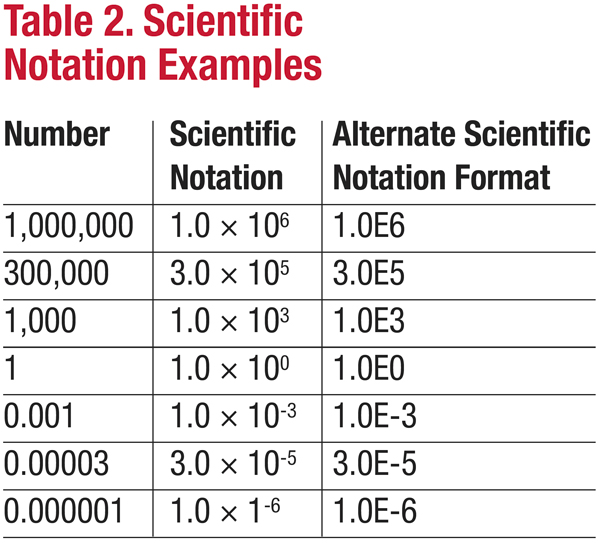
SI prefixes and the decibel are two shorthand methods we use to deal with very large and very small numbers. Another shorthand for large and small numbers is scientific notation, which expresses numbers in the format A × 10B. For instance, 300,000 = 3.0 × 100,000 = 3.0 × 10⁵. See Table 2 for more examples.
Scientific notation is commonly used to state bit error ratio (BER), sometimes called bit error rate, which, by definition is the ratio of errored bits to the total number of bits transmitted, received or processed.
For example, if 1,000,000 bits are transmitted, and three bits out of the million bits are received in error at the receiver, the BER is 3/1,000,000 = 0.000003. In scientific notation, 0.000003 is 3 × 0.000001 = 3 × 10⁻⁶, or 3.00E-6. (For more on the basics of scientific notation, see the operational practice SCTE 270 2021r1, Mathematics of Cable, available from SCTE’s standards download page at https://account.scte.org/standards/library/catalog/scte-270-mathematics-of-cable/).
Pop quiz time again
Which of the following is a worse BER: 1.00E-6 or 1.00E-9? This one’s not too difficult. 1.00E-6 = 0.000001 = 1/1,000,000, and 1.00E-9 = 0.000000001 = 1/1,000,000,000, so 1.00E-6 is the worse of the two because there are more errors (1 errored bit out of a million bits versus 1 errored bit out of a billion bits).
How about 1.00E-6 and 3.72E-6? Here we’re comparing 0.000001 and 0.00000372, or 1 errored bit out of a million bits versus 3.72 errored bits out of a million bits. So, 1.00E-6 is a better BER than 3.72E-6.
Wrapping up
We often deal with a lot of very big and very small numbers in our day-to-day jobs. Fortunately, there are several shorthand methods to make those numbers a little less cumbersome, such as the decibel, SI prefixes and units, and scientific notation. Thankfully we don’t have to deal with field meters that read signal level directly in watts.
 Ron Hranac
Images provided by author, Shutterstock