
Untangling the Hype
Automation, Machine Learning, and AI in DOCSIS Networks
In the broadband industry, terms like automation, machine learning (ML), and artificial intelligence (AI) are increasingly used to sell products, impress leadership, or justify investments. While these concepts have genuine value, their frequent misuse has created confusion. Vendors label basic scripts as “AI-powered,” and engineers are told their monitoring tools “learn”. We’ll define automation, ML, and AI clearly and use DOCSIS related examples to show how each term applies in practice, in an effort to cut down the noise. Understanding these distinctions isn’t just a matter of semantics, it’s essential for deploying the right solutions, setting accurate expectations, and making sound decisions in an era of complex broadband delivery.
Automation:
Rules without intelligence
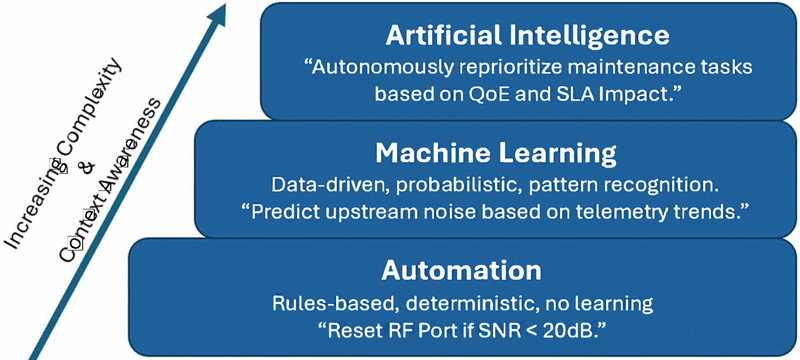
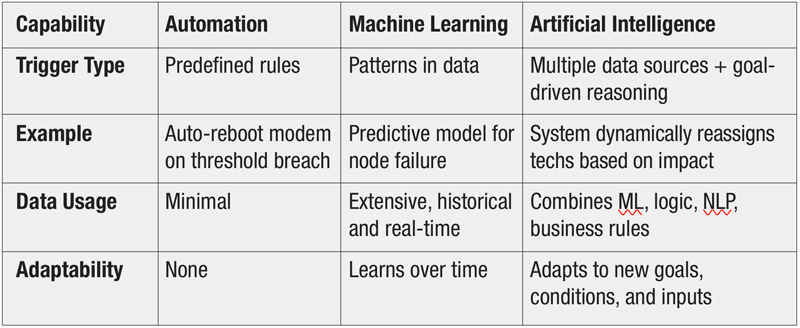
At its core, automation is about executing predefined tasks without human intervention. There’s no learning, adapting, or context-awareness, just repeatable workflows driven by logic and rules.
- Example 1: A scheduled firmware upgrade to a fleet of cable modems or a CMTS based on a maintenance window. The system performs a task based on a calendar entry or triggered condition.
- Example 2: An auto-remediation script that resets an RF port if the upstream SNR drops below 20 dB for more than five minutes. The logic is simple: IF condition A occurs, THEN execute action B.
These workflows are deterministic: given the same inputs, the system always behaves the same way. Automation excels at eliminating manual, repetitive tasks, reducing human error, and enforcing operational consistency. However, it doesn’t adapt to new data, recognize patterns, or improve with experience.
In DOCSIS networks, automation is often the first step in operational efficiency, but it is not “intelligent.” Labeling these rule-based systems as AI or ML only serves to inflate expectations and blur lines that matter.
Machine learning:
Systems that learn from data
Machine learning goes beyond hard-coded rules. It refers to algorithms that use data to improve performance on specific tasks. ML systems analyze patterns, make predictions, and adapt as more data becomes available.
- Example 1: Predicting upstream noise events by analyzing historical telemetry, such as variations in receive levels, modem ranging failures, or RxMER trends. An ML model can correlate these inputs to predict likely impairments before they affect service quality.
- Example 2: Clustering disconnect patterns across modems to identify hidden node issues. Unlike automation, which might reset a modem based on thresholds, ML recognizes complex behaviors: “These five modems across two taps frequently disconnect at similar times, indicating a possible shared impairment.”
Machine learning requires training data, model selection, and evaluation. It often uses probabilistic outputs, like “There’s a 78% chance this node will experience degradation in the next 24 hours.”
The value of ML in DOCSIS operations lies in its ability to process massive telemetry datasets and reveal insights beyond human perception. However, it doesn’t “think” or make judgment calls like a human would. It predicts but does not reason.
Artificial intelligence:
Emulating human-like decision making
Artificial intelligence encompasses systems designed to mimic human cognitive functions, reasoning, problem-solving, and context-aware decision-making. While ML can be a component of AI, AI is broader, often integrating multiple technologies to act with purpose and adapt to changing goals.
- Example: Imagine a virtual network engineer that monitors real-time performance, maintenance windows, customer impact, technician availability, and SLA obligations. Based on this information, it dynamically reprioritizes trouble tickets, reschedules proactive maintenance, and recommends routing configurations to optimize QoE (quality of experience). This system may use ML to detect issues but also relies on business rules, logical inference, and situational reasoning.
AI may also include natural language processing to understand technician notes, or decision trees to balance trade-offs (e.g., service restoration speed vs. cost of escalation).
Unlike ML, AI systems simulate goal-directed behavior, not just pattern recognition. They can answer complex “what should I do now?” questions in fluid environments. In DOCSIS networks, true AI could help orchestrate responses to cascading network failures or evolving service demands.
That said, few operational systems in use today exhibit real AI. What’s often sold as AI is, in practice, a mix of automation and lightweight analytics.
Why the distinction matters
Buzzwords have consequences. When automation is sold as AI, decision-makers may expect systems to “think” or solve new problems. When ML is mistaken for automation, teams may miss the opportunity to leverage predictive insights. Misusing these terms leads to overpromised capabilities, underdelivered results, and skepticism toward genuinely advanced tools.
For operators managing DOCSIS networks, clarity matters. When evaluating a vendor’s platform or building internal tools, it’s critical to ask:
- Is this deterministic automation or adaptive intelligence?
- Does the system learn from data, or follow hard-coded rules?
- Can it make decisions in novel scenarios, or only trigger predefined actions?
Recognizing the difference helps allocate budget effectively, build realistic roadmaps, and hold vendors accountable.
Conclusion
Automation, machine learning, and artificial intelligence are not interchangeable terms, they represent a spectrum of complexity and capability. In the context of DOCSIS networks:
- Automation handles the known and repeatable.
- Machine learning uncovers patterns and makes predictions from data.
- Artificial intelligence simulates reasoning and decision-making in dynamic environments.
Understanding these distinctions empowers network operators to adopt the right tools for the right tasks, avoid hype traps, and chart a path forward grounded in both technological capability and operational reality.
CableLabs in action:
Enabling ML and AI-driven DOCSIS intelligence
CableLabs has become a driving force in advancing automation, ML, and AI for DOCSIS-based networks—moving beyond definitions into real-world innovation and standardization.
- PNM Working Group The CableLabs PNM Working Group focuses on, among other things, how DOCSIS telemetry (such as full band captures, RxMER per subcarrier, and pre-equalization data) can feed advanced analytics and ML workflows. CableLabs is publishing best practices that leverage statistical methods and anomaly detection to diagnose impairments like LTE ingress, reflections, and other impairments before they impact users. For more information about the CableLabs PNM Working Group, see https://tinyurl.com/ysufph7h.
- Explainable AI for PNM Recognizing operator concerns about black box predictions, CableLabs is developing Explainable AI models for PNM that provide transparency into ML decisions, making anomaly detector outputs interpretable and trustworthy for anyone.
- AI/ML research and agentic intelligence CableLabs’ internal R&D labs now include ML powered systems capable of predicting network flows and performance issues before they occur. In a March 2025 blog, they introduced Agentic AI, designed to assist field operations by reasoning over maintenance factors, such as impact, availability, and QoE, to support intelligent decision making during network faults.
- Domain Specific Models & Knowledge Assistants CableLabs has experimented with doc focused LLMs like “NetLLM,” enabling users to query DOCSIS specifications via natural language—answering technical questions, summarizing concepts, or generating network training content automatically.
This body of work demonstrates that CableLabs isn’t just theorizing, it’s building and sharing scalable, interoperable tools that bridge rule based systems, predictive modeling, and goal oriented AI in DOCSIS environments. Integrating such innovations enables operators to move from reactive repair cycles to proactive, intelligent network operations.

Allen Maharaj
Principal Access Network Designer, Rogers Communications
Allen is a Principal Access Network Designer at Rogers Communications, specializing in access networks, DOCSIS®, and proactive network maintenance. With experience spanning design, installation, troubleshooting, and the operationalization of broadband technologies from the customer home to the core, he now focuses on evolving access network architectures to meet emerging demands. Allen’s work emphasizes practical strategies that balance customer experience with business realities such as cost, resources, and scalability. A frequent contributor to industry publications and conferences, he is recognized for combining deep technical expertise with pragmatic, forward-looking design.
Images provided by author, Shutterstock.