
Beyond the Safety-net
By Allen Maharaj
Beyond the Safety-net
Using DOCSIS® PMA as a Diagnostic Tool, not a Crutch
As broadband networks grow more complex and subscriber expectations continue to rise, maintaining a clean and high-performing RF plant has become both more critical and more challenging. In this environment, DOCSIS profile management application (PMA) has emerged as a powerful feature—one that improves reliability by allowing devices to continue operating even on impaired spectrum. But PMA is often misunderstood. While it enhances performance and resiliency, it’s not a fix for spectrum issues; it’s a sophisticated temporary fix. This article explores how PMA works, why it’s best viewed as a workaround rather than a cure, and how forward-thinking operators are using it as a diagnostic tool to drive network maintenance strategies.
PMA in practice
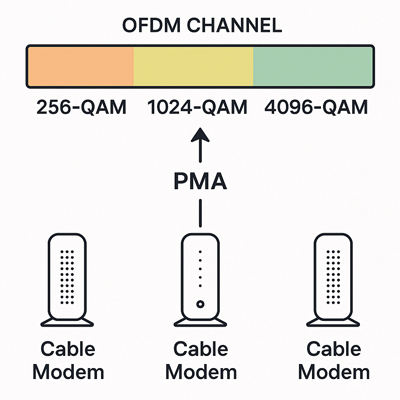
At its core, PMA enables cable modems and the CMTS to use different modulation orders based on each modem’s unique channel conditions. Instead of forcing all devices to use the same modulation orders, PMA tailors the parameters of downstream profiles or IUCs for a given channel. This allows devices experiencing signal degradation to fall back to more robust (but less efficient) modulation orders, while healthier devices can use higher-order modulations like 4096-QAM to maximize throughput.
By dynamically adapting to real-world conditions, PMA improves overall network capacity and stability and reduces the impact of channel impairments. It prevents poor-performing cabling and equipment from dragging down everyone and enables the network to operate with fewer hard failures. In this sense, it’s a huge step forward in efficiency and fault tolerance.
But that adaptability comes at a cost. PMA doesn’t solve the underlying problem of poor plant health; it just works around it.
The hidden cost of resiliency
Consider a return path with ingress or a downstream with reflections or suck-outs. Without PMA, these issues would manifest as poor performance or impaired modems, prompting troubleshooting and repair. With PMA, however, modems may continue to function, just at lower modulation profiles. That means the network keeps running, but the spectrum impairment remains hidden from both customers and operators.
In this way, PMA functions like a temporary fix: it covers the wound, so things look fine on the surface, but underneath, the problem festers. Left unchecked, this can lead to long-term degradation, customer churn, and higher operational costs when failures eventually surface.
From bandage to stethoscope
Here’s where the strategic opportunity lies. While PMA allows impaired modems to keep working, it also leaves behind a trail of clues. The very act of falling back to a lower profile is a signal, one that can be analyzed and acted upon. Operators can monitor which modems are using fallback profiles, how often they shift between profiles, and whether those shifts correlate with specific frequencies or time periods. A single modem dropping to a lower profile might be a fluke; a cluster of modems on the same node doing it points to a localized issue.
Metrics like modulation profile utilization, FEC rates, and OFDM subcarrier error patterns can all be harnessed to proactively detect issues before they impact service. In this way, PMA isn’t just a temporary fix, it becomes a stethoscope—helping technical resources listen for signs of trouble.
Turning insight into action
To truly benefit from PMA, however, operators need more than just data—they need process.
First, this means integrating PMA analytics into existing monitoring and maintenance systems. Tools and dashboards should highlight devices frequently using fallback profiles or exhibiting erratic behavior. Ideally, this should be automated, with threshold-based alerts and trend detection.
Second, operations teams must know how to act on this data. Not every profile fallback requires a truck roll, but a persistent pattern might justify proactive maintenance. Creating triage rules (e.g., number of modems affected, duration of fallback, severity of modulation drops) helps prioritize issues and avoid alert fatigue.
Finally, these insights should inform network health scoring and capital planning. PMA behavior can highlight chronically noisy areas or aging infrastructure, guiding segmentation, hardening, or fiber deep initiatives.
Real-world example
Now for a real-world example. Let’s say a group of modems on a particular node begins falling back from 1024-QAM to 256-QAM on the downstream. The network is still functioning, and customers aren’t complaining—yet. But PMA data shows consistent fallback on a specific OFDM subcarrier range.
Upon inspection, technicians discover corrosion on a connector introducing reflections. Without PMA, this might have triggered service calls or outages. With PMA and the right analytics in place, the issue was identified and resolved before it became a customer problem. This is the power of using PMA not as a crutch, but as a compass.
A proactive strategy, not a passive fix
It’s important to recognize that PMA is just one tool in the proactive network maintenance arsenal. Alone, it won’t clean up spectrum or replace the need for plant sweeps, ingress mitigation, or customer feedback. But when combined with telemetry, machine learning, and targeted field ops, PMA becomes a key input into a holistic network health strategy.
The challenge is cultural as much as technical. If PMA is treated as a way to delay repairs, it will lead to decay. But if it’s treated as an early warning system, it can help shift operations from reactive to proactive—saving time, money, and customer goodwill.
Looking ahead: PMA in the DOCSIS 4.0 era
DOCSIS PMA is a remarkable technology. It enables more efficient spectrum usage, improves reliability, and gives operators flexibility in managing diverse plant conditions. But it doesn’t fix bad cable, it doesn’t remove ingress, and it doesn’t repair broken taps. At best, it hides these problems. At worst, it lulls operators into complacency. To extract real value from PMA, service providers must go beyond the temporary fix. That means using profile fallback as a signal, building processes to interpret that signal, and investing in the operational discipline to act on it. The most successful operators will be those who treat PMA not as a mask, but as a map.
As operators look ahead to future deployments, PMA’s role becomes even more significant. With DOCSIS 3.1 supporting higher-order modulations like 4096-QAM, and industry research exploring even denser constellations such as 8192-QAM and beyond, the importance of clean spectrum continues to grow.
 DOCSIS 4.0 raises the bar even further by expanding usable spectrum—up to 1.8 GHz in frequency division duplex (FDD) or full duplex (FDX) DOCSIS operation. This makes even minor impairments far more impactful. Impairments that were tolerable under DOCSIS 3.1 can now severely impact DOCSIS 4.0, where sustaining higher modulation profiles is critical for delivering multi-gigabit speeds and meeting modern service expectations.
PMA helps bridge this gap by providing fine-grained adaptability across an even wider frequency range. But again, it’s not a fix—it’s a technical workaround. The broader and more complex the spectrum becomes, the more tempting it will be to rely on PMA to “keep things working” rather than confront physical layer issues head-on.
That’s why future DOCSIS-era networks must embed PMA into their performance intelligence and analytics. With more advanced telemetry, machine learning models can flag regions of profile regression, identify patterns over time, and correlate them with known plant faults or ingress trends. PMA data can also feed into node split prioritization, long-term capacity planning, or service-level assurance models.
Ultimately, the next generation of cable networks won’t just run on speed—they’ll run on visibility and precision. PMA is a key ingredient in that transformation—but only when used as part of a proactive strategy, not a passive workaround.
 Allen Maharaj,
Sr Manager, HFC Network Operations,
Rogers Communications
Allen is a network operations expert and technology strategist with a passion for solving real-world connectivity challenges—often with a dog by his side and a strong coffee in hand. Introduced to telecom as a kid, his experience spans design, installation, testing, and troubleshooting from the home to the core. He currently manages the HFC Network Operations team at Rogers, where he leads efforts to ensure operational stability across a large-scale broadband network. With deep expertise in routing, monitoring, and automation, Allen drives the adoption of orchestration and proactive maintenance to improve network reliability and customer experience..
Images provided by author, Shutterstock.