
At a Crossroads: Power, Infrastructure, and the Expanding Broadband Ecosystem
Over the past few months, I have had the opportunity to attend and engage in conversations across the industry at MetroConnect to NRECA’s PowerXchange and TechAdvantage to the NRTC Annual Meeting, and SCTE’s Chapter Leadership Conference. As you read this in May, I will also be on the ground at Fiber Connect, moderating two panels focused on rural broadband, community economics, and infrastructure planning.
Across all of these forums, one message has become increasingly clear. Digital infrastructure is at a true crossroads. This is not an incremental change. It is a fundamental reshaping of how our ecosystem operates, who participates in it, and what defines success.
At MetroConnect, that evolution was unmistakable. As Marc Ganzi, CEO of DigitalBridge, noted:
“We’re at a crossroads today, because what’s happening in our world, which has been narrowly defined as digital infrastructure, is now really colliding with general infrastructure… and it’s really happening at a power level.”
That collision is being driven by the rapid acceleration of AI, the exponential growth of data, and the physical realities required to support both. Conversations that once centered primarily on fiber routes, network expansion, and transactions have expanded to include energy strategy, grid capacity, and long-term infrastructure planning.
One idea surfaced repeatedly. Power is no longer a background consideration. It is foundational.
At MetroConnect, a simple but powerful framework made this clear. Power availability determines value. Without power, location alone does not create value. And power without transmission access risks becoming stranded.
This shift is redefining how infrastructure is evaluated, financed, and deployed. Grid capacity, transmission planning, and congestion are no longer adjacent concerns. They are central vari-ables shaping the future of digital infrastructure.
For those of us who have spent our careers in broadband, this represents a significant expansion of the ecosystem. Fiber remains essential, but it is now part of a much larger, more complex system that includes power generation, energy distribution, data center development, and compute.
That broader system was especially evident at NRECA’s PowerXchange and TechAdvantage, where electric cooperatives are already operating at the intersection of energy and connectivity. For these organizations, the convergence of power and broadband is not theoretical. It is operational. It is embedded in how they serve their communities every day.
It also reinforces the critical role of rural America in what comes next.
Rural communities are not on the periphery of this transformation. In many ways, they are at the center of it. With access to land, proximity to energy resources, and a history of cooperative models, these regions are uniquely positioned to support the next generation of infrastructure, including data centers and distributed compute environments.
But opportunity does not happen automatically. It requires coordination across stakeholders, thoughtful planning, and a clear understanding of how these systems must work together.
That coordination extends directly to the contractor community and the workforce responsible for building and maintaining this infrastructure.
As demand accelerates, the scale and complexity of what must be built continues to grow. This is not simply about deploying fiber faster. It is about integrating multiple infrastructure layers, often simultaneously, across diverse geographies and regulatory environments.
As Ganzi emphasized:
“If you’re a developer of digital infrastructure, you are now in the power enablement business. You have to be.”
That statement underscores a broader truth. The lines between sectors are blurring. Roles are evolving. And the success of any single project increasingly depends on the ability to align across disciplines that have historically operated independently.
Standards will play a critical role in this next phase. As infrastructure systems converge, the need for consistency, interoperability, and shared frameworks becomes more urgent.
This is already taking shape within the industry. The Telecommunications Industry Association (TIA), through its QuEST Forum, is advancing a new Data Center Quality Standard initiative designed to bring greater consistency, reliability, and accountability across the data center ecosystem (see article on page 16). As hyperscale investment accelerates and AI workloads drive unprecedented demand, the need for a common, certifiable framework is becoming essential to ensure infrastructure performs predictably at scale.
Organizations like TIA and SCTE are well-positioned to help guide this work, particularly as it relates to the physical build-out of networks, data centers, and the environments that support them.
In a different but equally important way, at SCTE’s Chapter Leadership Conference, the conversation shifted from infrastructure to expectations. As networks become more embedded in every aspect of daily life, the standard is no longer simply connectivity. It is consistency. Reliability. Presence.
As Andy Parrott shared in his keynote:
“We are expected to be always on. And not just always on, but always working, always available, always seamless.”
That idea resonated with me in a very personal way.
Earlier in my career as a senior executive at Bright House Networks, we launched what was initially conceived as a marketing campaign, but ultimately became something much more. During the campaign briefing, the premise was introduced as “always there, always on,” followed by a simple question: Who does that remind you of?
A friend.
What began as a marketing concept quickly evolved into a broader cultural and brand platform, shaping how we showed up for both our customers and each other. Communications sat at the center of that work, connecting product, marketing, and the employee experience into a shared understanding of what it meant to serve.
Today, that expectation has only intensified. Always on is no longer a brand promise. It is the baseline.
And that brings us back to the broader transformation underway.
We are no longer building standalone networks. We are participating in the development of integrated infrastructure systems that will shape how communities live, work, and grow for decades to come.
The decisions being made today around power, fiber, compute, and standards are not isolated. They are interconnected. And they will determine which regions are able to compete, attract investment, and fully participate in the next phase of the digital economy.
There is still much work to be done, particularly in rural communities where the need remains great and the opportunity is significant. But there is also momentum.
Having grown up in rural America, this is not abstract to me. I have seen firsthand what access, or the lack of it, means for individuals, families, and entire communities. What is unfolding now carries the potential to reshape those realities in meaningful and lasting ways.
At the same time, I am seeing a broadening of how we define this industry. What was once more narrowly understood as cable or even broadband is expanding into a much larger, more interconnected ecosystem that includes energy, data centers, cloud, and compute, and even low Earth orbit satellite networks extending reach in entirely new ways. As that expansion occurs, certain segments are evolving, redefining their roles within this larger system. That evolution is not a loss, but a reflection that the industry itself is maturing into something more integrated and even more impactful.
What I have seen across these past few months is an industry that has been broadening and integrating for some time, now aligning more intentionally across sectors around a more unified view of infrastructure, with a growing recognition that no single part of the ecosystem can operate in isolation.
We are at a crossroads. But we are also at a moment of possibility. And how we respond will shape not just our networks, but the future of the communities we serve.
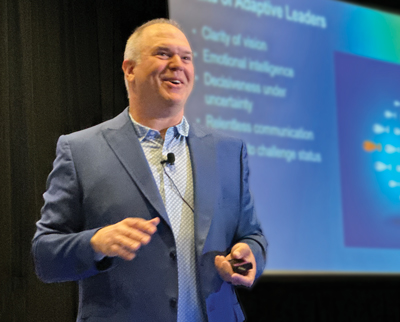
Andy Parrott, CEO, Vyve Broadband

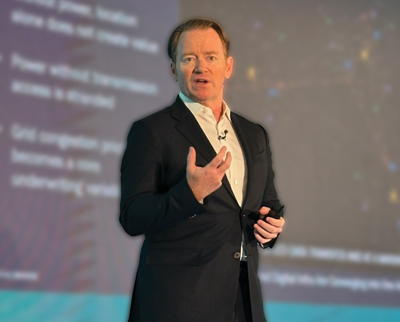
Marc Ganzi, CEO, DigitalBridge


Opening ceremonies at NRECA were especially powerful, reflecting the pride and service that define rural America. It was an honor to be part of it.


Images, Provided by author, Shutterstock