
50G, Coherence, and the Emergence of the Adaptive Network
When CableLabs President and Chief Executive Officer Phil McKinney began his keynote at SCTE TechExpo on September 29, 2025, he led with what he described as a “strong and provocative statement,” telling the room that “we are about to talk about 50 gigabits.” In that moment, I believe he was doing more than naming a number. He was signaling a shift in perspective, a reframing of how we imagine the future of broadband. For me, the significance was not the metric itself, but the mindset it represented and the direction it pointed toward.
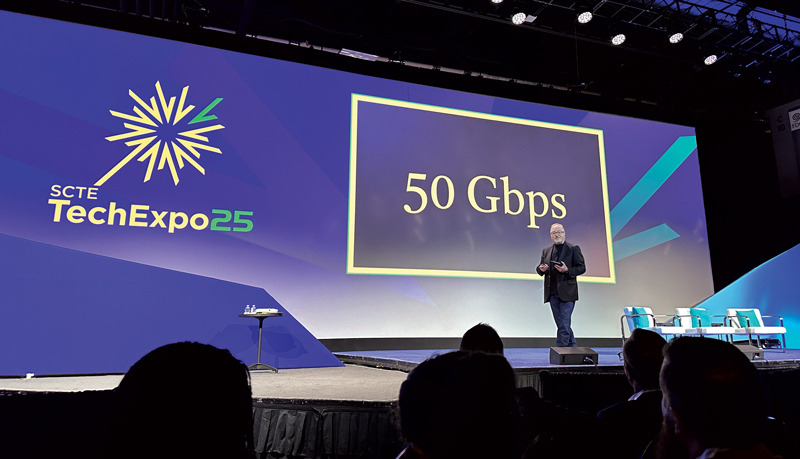
The conversation was no longer centered on speed as the primary indicator of progress. What I heard was an invitation to think differently about how networks will behave. The sense that we are moving into an era defined less by throughput and more by intelligence, coherence, and adaptability. Sitting there, I realized I was not simply listening to a technical update. I was hearing the language for a new architectural mindset.
As someone who has long been fascinated by the unseen patterns that influence human experience, I felt an immediate resonance. I am drawn to the structures beneath our awareness, the energetic and informational layers we respond to even when we cannot see them. In broadband, the unseen takes a very different form. We work with signals, light, frequencies, and patterns that never appear to the human eye, yet they determine how the modern world connects. Technologists build, measure, and optimize these invisible layers every day, often without thinking about the fact that most people never perceive them at all. The idea that networks may begin to behave less like static pipelines and more like adaptive systems feels not only plausible, but like a natural extension of how invisible systems function in many areas of life.
What the industry signals revealed
Across conversations with leaders at SCTE TechExpo and throughout the year, a consistent pattern has emerged. Many operators, including Comcast, Charter, Cox, Liberty Global, and others, have been preparing for a world where networks must evolve dynamically. Their investments in HFC, fiber densification, automation, coherent optics, telemetry, and distributed access architectures were not about strengthening yesterday’s systems. They were about designing for a future that requires far more flexibility and awareness.
When the emphasis shifted from speed to intelligence and the conversation turned to networks that can adapt, learn, anticipate, optimize, and reconfigure automatically, it brought a new clarity to a trajectory that has been gaining momentum. It highlighted a form of situational awareness that has been evolving gradually through decades of engineering and foresight.
The future already arriving
For the past several years, the 10G Platform framed how we talked about performance. Phil reframed the future decisively. He walked the audience through DOCSIS 1.0 to DOCSIS 4.0, from 1 gigabit to 25 gigabits, and then stepped into the real pivot. “The future would not be just about speed.” He pushed the conversation toward coherence.
Three weeks later, at Broadband Nation Expo, I sat in the front row for Comcast Executive Vice President and Chief Network Officer Elad Nafshi’s keynote. It was not theoretical. It was evidence of what the Adaptive Era looks like in practice.
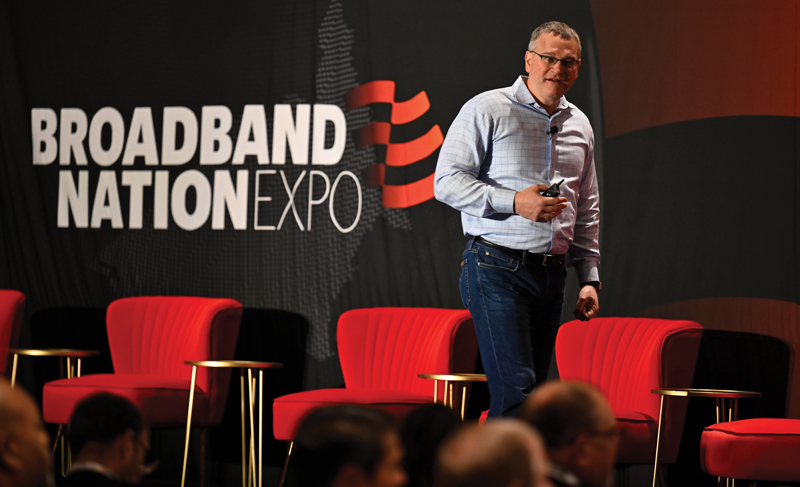
AI-generated traffic on Comcast’s network has tripled. One AI-based video application now consumes more bandwidth than Xbox Live.
Demand curves are evolving faster than traditional forecasting models imagined.
What stood out most was the design of their network. Comcast had already built the automation, multi-gig HFC capacities, deep fiber footprint, telemetry, and software-driven intelligence required to absorb these shifts. Their network was not reacting to the future. It was prepared for it.
Hearing Phil’s directional framing and Elad’s operational confirmation within weeks of each other revealed something unmistakable. The Adaptive Era is not something we are waiting for. It is something we have already entered.
The shift from speed to coherence
What emerged through both discussions was a clear theme. The future of broadband will not be defined solely by higher speeds. It will be defined by coherence, a concept that appears across optics, physics, engineering, and systems thinking. Coherence implies alignment and readiness. Increasingly, it describes the direction our networks are evolving toward.
Technical coherence
Made possible through coherent optics that dramatically increase fiber capacity. In his keynote, Phil pointed out that the next generation of coherent optics could enable as much as 50,000 gigabits of capacity on fiber, a scale that reshapes what becomes possible when networks operate as unified, intelligent systems rather than isolated components.
System coherence
Achieved through convergence across HFC, fiber, Wi-Fi, mobile, and edge networks.
Conceptual coherence
Recognizing that networks must behave as unified, adaptive systems rather than independent components.
A personal reflection on unseen architecture
For years, I have been drawn to the invisible structures that shape how we live. People intuitively sense patterns, shifts, and signals they cannot see. They make decisions based on alignment, instinct, resonance, or subtle cues that operate beneath conscious awareness. This is part of being human.
In broadband, we work with invisible forces every day, though of a very different kind. Engineers measure signal levels, spectral performance, and light transmission that never appear to the naked eye, yet these forces determine how modern connectivity functions. Most people never perceive these layers directly, even though they rely on them constantly.
Most people question unseen human experience.
They rarely question unseen network behavior.
As networks evolve into systems capable of sensing, predicting, and adapting automatically, these two worlds begin to echo one another in meaningful ways. Not because networks will ever be conscious, but because they will increasingly function with a kind of systemic awareness that mirrors the complexity of living systems.
Closing reflection: The mindset that will shape what comes next
Phil often challenges innovators to begin with a simple question: what problem are we trying to solve?
In the last issue of Broadband Library, Rouzbeh Yassini-Fard reminded us that the purpose of the network is not simply to transport information, but to expand what is possible for people. His perspective reinforces that the future of broadband is always intertwined with the future of humanity.
So perhaps the question becomes a both/and: What kind of network are we building, and what kind of awareness will we bring to its creation?
Reflecting on both perspectives, I am reminded that the challenge ahead is not purely technical. It is human. It is whether we can recognize the larger pattern that is emerging and step into it with the awareness it requires.
50G is the engineering milestone: the signal.
The adaptive network is the architectural milestone: the canvas.
Systems awareness is the conceptual milestone. What we choose to build on it will define the next generation of connection.
Looking Ahead Through Coax
In the Summer 2023 issue of Broadband Library, Ron Hranac explored the capacity of coaxial cable and what it might one day support, offering an early glimpse into the possibilities now beginning to surface across the industry. His analysis showed that using up to 6 GHz of bandwidth in coaxial cable could accommodate roughly 25 Gbps symmetrical speeds, or about 50 Gbps combined.
Read the full article: https://broadbandlibrary.com/the-untapped-capacity-of-coaxial-cable

Kimberly Maki
Strategic Advisor, Broadband Library
Kimberly Maki is a seasoned executive and veteran communicator of technology with over 35 years in cable, broadband, and ICT. Kimberly has built her career around translating complex technologies into strategic communications, high-impact member engagement, and record-setting events across five continents. She served as Corporate Vice President/Chief Communications Executive at Bright House Networks, Vice President of Public Affairs at Time Warner Cable, and Executive Director of the Society of Motion Picture and Television Engineers. She also held Vice President roles at SCTE and BICSI. Earlier in her career, she served as Director of Public Affairs for a statewide cable association and as an account manager and published author at a public policy think tank, advancing legislative understanding of cable technology through strategic communications and technical advocacy. As CEO of Influential Voices, she now leads strategic growth initiatives for technology and member-driven associations worldwide.
Images, Shutterstock