Why Ruggedized Connectivity Is Critical for the Future of Fiber Deployments
As our fiber networks extend deeper into neighborhoods, cities, and rural regions, the access network layer of broadband infrastructure has undergone a profound shift. Instead of living in controlled spaces such as headends and central offices (COs), today’s last-mile architecture increasingly resides in the outside plant (OSP), where components must endure heat, freezing temperatures, UV exposure, moisture, vibration, and decades of mechanical stress. These environmental forces introduce real network operational risks, including optical instability, long-term attenuation drift, and customer service interruptions. With our current network deployment approach, one component has become central to protecting network performance and long-term investment: the hardened data connector, or HDC. Once used mainly in specialized outdoor applications, HDCs have evolved into a foundational element of fiber-to-the-x (FTTx), HFC/fiber-deep, and converged access networks. Their value lies not only in ruggedness but in their alignment with how modern OSP networks must now be designed, maintained, and scaled for reliability.
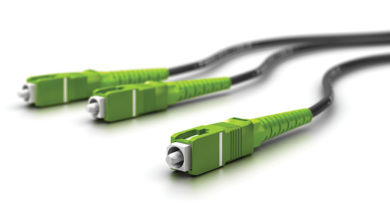
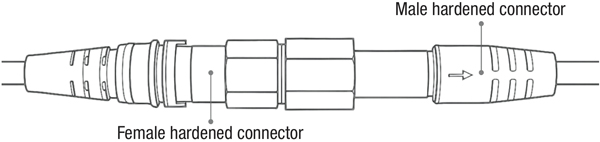
HDCs are built specifically for OSP conditions defined by Telcordia and International Electrotechnical Commission (IEC) standards such as GR-3120, GR-3171, GR-326, and IEC 61753. While they maintain familiar optical formats such as SC/APC, LC/APC, or MPO/MTP, they encase these ferrules in housings built for harsh environments. High-impact, UV-stable composites resist long-term material degradation, while internal O-rings, gaskets, and hydrophobic barriers prevent ingress from water, dust, and chemicals. Many hardened connectors meet IP67 or IP68 protection levels, ensuring they remain sealed even during temporary submersion. Mechanical keying, strain-relief structures, and bend-radius controls prevent alignment shifts or microbending caused by thermal expansion or vibration. By isolating the fiber interface from the environment, these connectors maintain a stable optical path even after years of service.
Environmental resilience is the most immediate advantage of hardened connectivity. OSP networks regularly face temperature swings from –40 °C to +75 °C, along with humidity, salt fog, and prolonged sunlight, conditions that rapidly degrade traditional optical connectors. Real-world hazards, including windborne debris, landscaping accidents, wildlife interactions, and ice loading, introduce additional stress. Unprotected connectors exposed to the environment are vulnerable to ferrule misalignment, moisture condensation on the endface, UV-driven brittleness, and contamination that increases insertion loss. Over time, these issues manifest as intermittent failures, rising attenuation, or chronic trouble tickets that drive up operational costs. HDCs counter these failure modes through sealed ferrule cavities, thermally stable housings, and design features that prevent shock-induced movement. They preserve optical alignment and endface cleanliness, ensuring that link budgets remain intact throughout the network’s operational lifespan.
Transforming installation practices
Beyond environmental performance, HDCs have fundamentally reshaped installation and maintenance strategies. Traditional FTTx and HFC deployment models depend on field fusion splicing, which requires expensive equipment, controlled workspaces, specialized workforce microcredentials, and longer installation intervals. Each splice introduces variability and adds time to activate a subscriber. Hardened connectivity replaces much of this complexity with a predictable plug-and-play approach built on factory-polished, pre-terminated drops. Technicians simply plug the hardened drop into a multiport service terminal (MST) or enclosure, check light levels, and complete the job in minutes, reducing contamination risk and ensuring the optical interface remains clean and sealed.
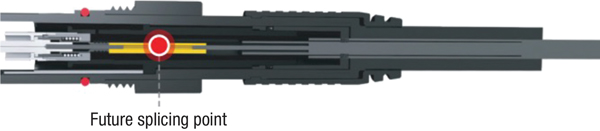
In parallel, operators now have the option to use splice-on HDCs, which combine the flexibility of field splicing with the environmental durability of hardened housings. This hybrid method lets technicians create exact drop lengths on-site while still delivering a fully sealed, O-ring-protected hardened connector. Splice-on HDCs are especially useful in retrofit work, MDUs, and rural routes where precut drop lengths don’t fit. Together, pre-terminated and splice-on hardened solutions reduce inventory complexity, minimize waste, speed up installs, and improve long-term serviceability, directly contributing to lower OpEx and more scalable field operations.
Enhancing operational efficiency
This streamlined approach directly benefits operational efficiency. Faster installations mean more completed jobs per day, reduced dependence on highly skilled splicers, and a workforce that scales more easily with growth. Providers facing aggressive fiber-build timelines, workforce shortages, or rising labor costs can deploy hardened fiber architectures more consistently and efficiently. In many organizations, HDC-based installation strategies have become a major driver of improved OpEx by reducing technician training time, simplifying job workflows, and cutting repeat truck rolls due to environmental failures.
The benefits extend into maintenance operations. Customer optical drop cables are some of the most frequently damaged components in the access network, whether due to lawn equipment, home renovation, animal activity, or storms. Traditionally, repairing a drop requires a truck roll with a splicer, access to the fiber handhole or splice case, and time to prepare and protect the enclosure. Hardened connectors enable a modular approach: The technician disconnects the damaged drop and plugs in a replacement without disturbing distribution fibers or reopening sealed closures. This reduces mean time to repair (MTTR), lowers labor OpEx, and improves the customer experience, key metrics in today’s competitive broadband landscape.
Hardened architectures also improve cable management. Because drop lengths are factory-determined or with splice-on connectors, excessive slack is reduced. Installations look cleaner, terminals remain easier to maintain, and long-term OSP organization improves. These factors reduce the human error factor (HEF), improve serviceability, and directly contribute to lower lifecycle costs.
A core advantage of hardened connectivity is that the rugged housings protect standard optical interfaces. SC/APC remains the dominant choice in our fiber networks, while LC/APC is increasingly common in space-constrained MDU/city applications, and MPO/MTP forms the backbone of multi-fiber distribution for 5G, small cells, and campus networks. This ensures compatibility with existing xPON optics, OTDRs, optical power meters (OPMs), inspection scopes, and network design tools. Operators can introduce hardened terminals, wall boxes, and outdoor splitters without redesigning optical power budgets or retraining their entire workforce on new connector types. As networks densify in MDUs, campuses, and mixed-use developments, hardened LC and MPO variants are expanding rapidly due to their higher fiber density and support for compact terminal designs.
HDCs are no longer limited to FTTx and HFC architectures. They are now widely deployed in outdoor small-cell nodes, mid-span aggregation points, rural broadband cabinets, and industrial IoT, transportation corridors, smart city infrastructure, utility grid communications, and military or hardened government networks. Anywhere fiber must operate outdoors with high reliability, hardened connectors deliver the sealed, stable interface required for longevity.
This shift toward ruggedized, modular connectivity aligns with the broader industry movement toward lifecycle optimization, sustainability, and operational resilience. Providers must build networks quickly yet maintain them efficiently for decades. Hardened connectors lower total cost of ownership by reducing environmental failures, minimizing field labor, shortening restoration times, and supporting rapid upgrades. As multi-gigabit PON (e.g., XGS-PON), symmetrical service expectations, and edge-cloud architectures place increased performance demands on our access networks, connection reliability becomes foundational to customer experience and service outcomes.
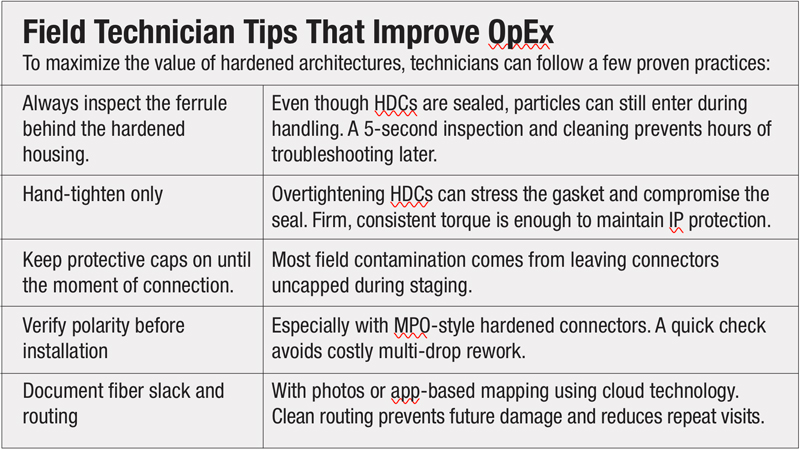
These quick habits reduce contamination-related loss, prevent unnecessary truck rolls, and extend the life of connectorized drops, directly improving OpEx.
Hardened connectors deliver a sealed, stable, predictable interface that withstands real-world conditions while enabling faster deployment and more efficient operations. As fiber access network architectures expand, hardened connectivity will remain a foundational element of reliable digital service delivery for homes, businesses, and communities.

Steven Harris
Founder, Harris DigiTech
steve.harris@harrisdigitech.com
Steve Harris is a globally recognized broadband leader with 30+ years as an entrepreneur, corporate executive, and professor. Pioneering workforce skills development, he’s a FOA/Cisco/CWNP instructor, published author, and patent holder. Known for strategic partnerships and closing the digital skills gap, he actively supports industry organizations and trade events..
Images provided by author, Shutterstock.