S.T.R.I.K.E.
Standing Together to Protect America’s Critical Communications Infrastructure
By Elad Nafshi, Chair, and Tom Monaghan, Vice Chair, S.T.R.I.K.E.
Every day, people across the United States rely on the networks we build, operate, and protect. They rely on us when they call 911, when they check into a hospital, when they run a business, when they attend school, and when they connect with loved ones. As leaders responsible for delivering reliable communications to millions of Americans, we understand the gravity of that responsibility.
Over the past two years, we have seen something deeply concerning. Criminal attacks on communications infrastructure have escalated sharply. These are intentional incidents that sever fiber lines, damage network equipment, and disrupt essential services. The consequences are immediate and threaten public safety. Families lose the ability to reach 911 and emergency services. Hospitals lose access to critical systems. Businesses cannot operate. Even federal agencies and military installations have been affected.
To fight this growing issue, the industry launched S.T.R.I.K.E – Strategic Threat Response & Infrastructure Knowledge Exchange. Our mission is clear. We are joining forces across the industry to strengthen enforcement, improve prevention, and ensure that criminals who attack the nation’s communications systems face real consequences.
This issue is not theoretical. These criminal attacks are happening today in communities across the country, and it is time to confront it with the seriousness it deserves.
What we are seeing nationwide
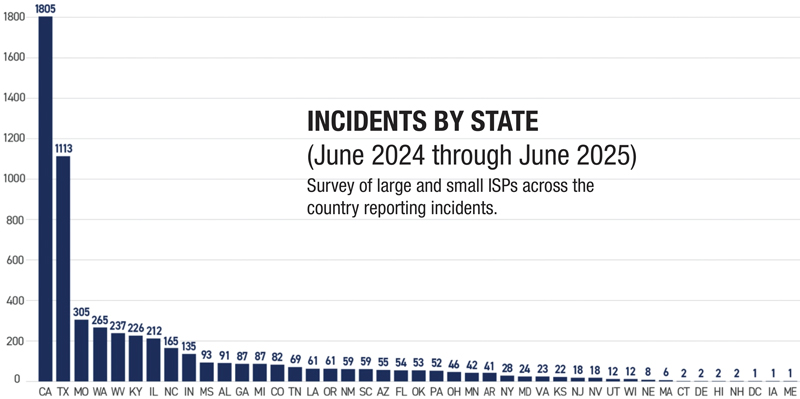
Across the industry, the numbers tell the same story. From January to June of 2025, 9,770 incidents of intentional theft or sabotage on communications networks were reported, nearly double the number reported in the prior six-month period. More than 9.5 million customers have been impacted by the 15,540 attacks experienced over that 12-month period. That averages out to 1,295 incidents a month or 43 per day.
With more than 6,000 attacks reported in California between June 2024 and June 2025, the state has experienced the most significant attacks in the country. In one Los Angeles event, criminals cut 13 fiber optic cables in a coordinated strike. More than 50,000 residents lost phone and Internet services. Multiple 911 centers went offline. Emergency dispatch systems went dark. A military base lost critical communications. These events jeopardized public safety and national security.
Our teams have witnessed these incidents firsthand. They arrive at the sites and find fiber lines intentionally cut with tools, equipment opened or burned, or conduits ripped apart by individuals looking for copper. Many perpetrators do not realize that modern fiber contains no copper at all. By the time they discover there is nothing to steal, the damage is done, and entire communities suffer for it. Regardless of intent, these attacks disrupt essential services and place communities at risk.
Why S.T.R.I.K.E. was created
1. Stronger laws and penalties
Twenty-eight states have passed felony statutes that impose real consequences for intentional damage to communications infrastructure. These laws matter, and they are already helping law enforcement pursue these cases more effectively. We are looking for similar legislation in the remaining states to increase the consequences faced by those responsible for these criminal attacks. But the threat does not stop at state borders. We believe federal action is also essential to create consistent penalties nationwide.
2. Partnerships with law enforcement
Law enforcement agencies have been invaluable partners. In California, increased inspections at recycling centers and clear direction from city attorneys have resulted in new investigative leads and arrests. We want to support additional jurisdictions in building similar programs to make it more difficult for stolen materials to be sold and ensure that proper identification is collected by recyclers with every transaction. This ensures that when stolen materials are identified they are accompanied with information on the seller to assist law enforcement investigations.
3. Better industry coordination
Through S.T.R.I.K.E., companies are sharing data about outage patterns, tools used in attacks, geographic trends, and response strategies. Faster information sharing leads to faster recovery and better prevention.
4. Increased public awareness
Community members who report suspicious activity can prevent a major outage or assist law enforcement. Companies across the industry have created tip lines and reward programs. These partnerships are already making a difference.
What we are asking policymakers to understand
All communications technologies, including wireless and satellite, rely on physical infrastructure being impacted by these increased attacks. The question is whether our nation will treat these crimes with the seriousness they deserve and pass critical legislation that would ensure attacks on private networks carry the same federal penalties as attacks on government systems. Beyond passing legislation, policymakers can play a critical role in strengthening enforcement, supporting law enforcement partnerships, and elevating the importance of protecting critical infrastructure. This includes working to ensure tough scrap metal laws are in place to deter the purchase of stolen metals and materials, that recyclers are following regulations, and when they don’t, they are held accountable.
Moving forward together
As Chair and Vice Chair of S.T.R.I.K.E., we are committed to protecting the networks that the people of this country rely on every day. We believe this effort requires collaboration across the communications ecosystem, along with strong engagement from governments, law enforcement, and the public. We are determined to ensure that the nation’s networks remain strong, resilient, and secure. The threat is real. The impact is immediate. The time to act is now.

Elad Nafshi
Chief Network Officer, Comcast
Elad Nafshi serves as Executive Vice President, Chief Network Officer for Comcast Connectivity and Platforms. In this role, he leads the unified core and access network teams that drive innovation, reliability, scalability, and development across the company’s network capabilities. Elad drives strategy for the nation’s largest gigabit Internet network and is a global leader in 10G technology, which will allow Comcast to deliver multigigabit upload and download speeds to tens of millions of Americans.
Images, Shutterstock, and chart provided by authors.

Tom Monaghan
Executive Vice President, Field Operations, Spectrum
Tom Monaghan is Spectrum’s Executive Vice President, Field Operations, and leads a team of approximately 30,000 employees. He oversees Spectrum’s nine operating regions, as well as Field Operations’ engineering and construction teams, supply chain management, and business planning. He was inducted into the Cable TV Pioneers and serves on the Board of Directors for the Syndeo Institute at The Cable Center and the Society of Cable Telecommunications Engineers (SCTE).
Images, Shutterstock, and chart provided by authors.