Fast Times, Grand Visions
Revisiting the Cable Modem Road Trip
Among the enduring signposts: a little-known town, early government implementations, and one great big giveaway
By Rouzbeh Yassini-Fard, with Stewart Schley
Among the many signature events propelling the broadband revolution, one influential moment has been obscured by far more visible developments that have happened over the past 38 years. Chances are good that even the most connected of industry insiders know nothing of it. Yet the fact is that tucked into the history of cable’s broadband transformation is the contribution of a tranquil town not far from Boston: Stow, Massachusetts.
In the autumn of 1989, in this pastoral Middlesex County community (think apple orchards and meandering two-lane roads), something vital to cable’s future happened.
And that was this: The modem my small company was implementing didn’t work.
Or, more accurately, the network architecture to which our modem was attached didn’t work. For reasons that, immediately in the moment, we simply couldn’t fathom.
“We” refers to a small band of determined engineers and developers who were convinced we could transform the nation’s cable infrastructure into something alien to its television-centric origins: a mechanism for forklifting the wonders of the high-speed, Ethernet-powered local area network from a confined office environment to an entire city. Borrowing from both concepts, I chose the name LANcity for my newborn company.
My associates and I were devoting all the brainpower, ingenuity and willpower we possessed to develop a new sort of telecommunications modem—a device powered by breakthrough software and a network management system that would allow us to transmit digital data over the residential cable infrastructure at astonishing speeds.
Except: When we deployed our cable modem technology for a first-ever field trial over a residential cable system, we were nothing but disappointed. I still remember staring at a computer monitor planted on the carpeted floor of a home on a quiet cul de sac in Stow. The house on Packard St. was owned by one of my companions from Digital Equipment Corp., the nearby computing industry giant that had become intrigued by our work. Generously, my friend had agreed to contribute his living room as our first real-world test bed.
From our vantage point there in the room, everything seemed fine. A succession of fans inside our oversized modem were whirring away. The physical connections were solid. Lights were blinking from the front panel of our modem as they should have. But a digital file we were attempting to transmit from a home not far away (on Peabody St., as I recall) was nowhere to be seen. There was no evidence of any sort of connectivity happening over a two-mile stretch of coaxial cable maintained by the cable company serving Stow, Nashoba Valley Cable TV. The same technology stack that had worked so well in other implementations wasn’t working here.
We were mystified. And as it would turn out, being mystified was important. The realization that our architecture was not ready for prime time in 1989 was instructive. I took it less as an abject failure, and more as a sort of real-world reality check, a blueprint for inspiring innovation.
Over the succeeding months, prowling the streets of Stow while armed with a power generator, a signal level meter and a rented utility van, we addressed challenges other companies would take years to internalize: How our modem had to be architected and designed to perform flawlessly within various iterations of a challenging cable television upstream path. How entirely new filtering mechanisms would have to be developed and put into place. How the engineering principles associated with one-way TV channels would need to be re-imagined for the world of high-speed data over two-way networks. And in some cases, how difficult it sometimes could be to pry open amplifiers whose bolts had become badly rusted.
First principles
What kept the dream alive was a conviction that what we were trying to do was entirely within the realm of the possible. We weren’t trying to rewrite the canon of physics or mathematics. We were adhering to “first principles,” the immutable rules that govern our world’s reality. Besides that, we were almost spiritually devoted to achieving the original vision I had laid out for our small team in the living room of a colonial-style home in Reading, MA, owned by one of my associates.
My vision was a bold one; possibly even a bit audacious. I was convinced we could create an entirely new ecosystem for communicating. We could ease the strain on our planet’s resources by moving information, not objects or people. We could connect families, institutions, companies, governments and everyday citizens with a level of speed and power unimaginable in the early days of online services. We could help ordinary people make a generational pivot from being passive consumers of information and applications to being active producers of information and applications.
And importantly, we could do so over an existing, deeply penetrated infrastructure built by determined entrepreneurs, supported almost entirely by private capital, and churning away across most of America to deliver an assortment of increasingly popular television channels.
Cable television, of course.
And so: Again we returned to the scene of the crime. Same town, same cable system. First, to try out a newer cable modem targeting business and commercial users. And not long after, to implement an even smaller and more affordable cable modem, this one designed for the mass-market residential environment.
Once more, we encountered a laundry list of troubles. And once more, we took them on, working as a team, laboring deep into the evening, and again leaning on fundamental principles of mathematics and physics. In the end, as critical deadlines loomed, we experienced our eureka moment. A remedy we had devised in the space of days for overcoming tricky frequency disparities worked beautifully. Now, the data streams running over this very same cable TV system were functioning exactly as intended, hurling bitstreams up and down the cable pipe with an assuredness and force that was breathtaking.
We had tamed hundreds of technical obstacles in achieving a key marker on our technical journey. And with no particular fanfare, we had turned the small town of Stow, Massachusetts into a signature signpost on the way to today’s sprawling, global broadband ecosystem. It’s not entirely a stretch to declare that the road trip to the modern information highway began in a humble New England town.
Timeline.Download
Government’s role
Behind what we had accomplished in Stow, and predating our success there, was a source of energy that often is overlooked: the contributions of government and public agencies. Preceding our work to bring high-speed data networking to Stow, and to the cable industry at large, was a succession of implementations involving dedicated coaxial cable networks maintained by public organizations: municipal school districts, local utilities, hospitals, university campuses, and even one of the nation’s vital military logistics sites, the Rock Island Arsenal fronting the Mississippi River near Davenport, Iowa.
Here, a caveat: These implementations ran over private, carefully tended cable systems that featured important distinctions relative to the mainstay residential cable architecture. But they were close enough to register as the legitimate forerunners of today’s cable-broadband infrastructure.
And that was important. Had managers of these facilities not rolled the dice with us on the faith that there was a better way to connect computers and their users, there likely would have been no path forward, no funding available to us, and no way to continue. At the time, these public-sector customers were all we had. For all the cable industry’s deserved acclaim as the centrifugal instigator of game-changing broadband connectivity, the reality is that until around 1993 or so, the industry at large hadn’t yet embraced the data-over-cable proposition. I remember a telling moment during the 1990 National Cable Show in Atlanta, organized by the (then-named) National Cable Television Association. LANcity was one of dozens of small-time exhibitors, steadfastly manning small, inexpensive and often overlooked tabletop displays located in the nether regions of the exhibit floor. We were far away from the lavish, neon-lit booths maintained by industry standard-bearers like HBO or General Instrument Corp. Still, I was flattered when a senior executive from the mighty Tele-Communications Inc. (TCI) strolled by and politely listened to my pitch for transforming the cable infrastructure into a data-delivery machine. But I was deflated to hear his conclusion. “Son,” he told me, “I’m afraid you’re at the wrong convention. We do television here. Not computers.”
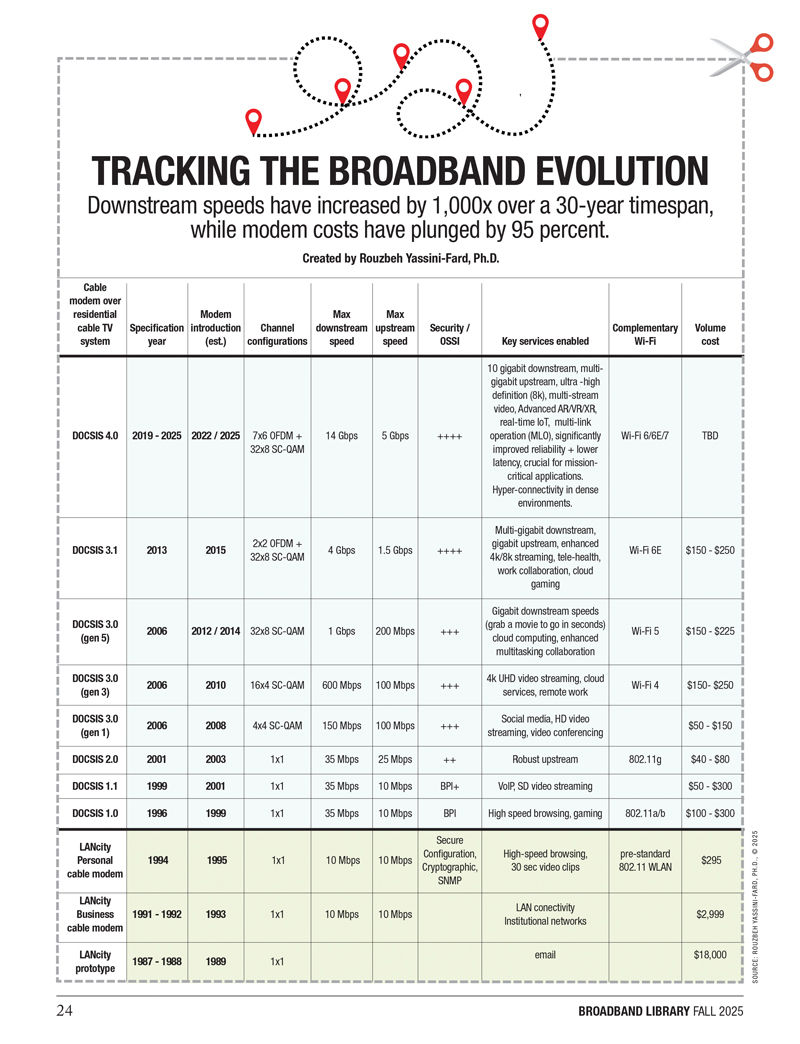
Fair enough. Technology’s advance doesn’t happen in a flash cut. It happens iteratively, over time, until the tipping point is reached, and the whole thing accelerates in terms both of technological capability and economic affordability. As the table appearing on the following page of this article shows, this progression continues to build momentum today, as a global engineering evolution contributes ever-expanding capabilities in speed and performance, twinned with dramatic decreases in cost.
In no small measure, this evolution was powered by the cable industry, where sentiment about broadband changed dramatically in a short period of time as part of a sort of harmonic convergence took place. My company and others poured energy into new, improved modems at the same time that cable companies injected billions of dollars into bidirectional, fiber-infused systems, and as the NCTA wisely advocated for a “light touch” regulatory approach that encouraged a flood of fresh investment in the emerging cable-broadband proposition.
The takeaway here is that it really does take a sort of village to bring technology to life at scale. In the end, non-partisan government support was paired with private innovation and investment to create a whole bigger than the sum of its parts, an American dream gifted to the rest of the world.
The power of standards
That, and another key ingredient: standardization. The DOCSIS® initiative undertaken by the cable industry and led by a superstar group of visiting engineers was the engine behind a virtuous cascade of scale, cost and predictability that would become transformative. Today, broadband connectivity is the No. 1 revenue source for the domestic cable industry, outstripping the economic contribution of the legacy television services that for decades supplied cable with its oxygen. To have played a role in the formulation of the cable modem interoperability and standardization efforts led by CableLabs remains a career highlight. And having done so alongside so many talented minds is the chef’s kiss of a memorable achievement.
Finally, somewhere in this mix of private entrepreneurship, government support, collective willpower and professional dedication is one more important driver of advancement: a conviction that there’s more to the game than money. To be sure, one of capitalism’s roles is to reward successful innovators with riches. And rightly so. The pursuit of economic success and the personal notoriety that comes with it remain essential allures for individuals who are determined to put, as the late Apple co-founder Steve Jobs once phrased it, “a ding in the universe.”
Hat tips all around. But I like to think there remains a place for a type of personal reward that transcends the bank account. One accelerant for the cable-broadband ecosystem was the decision by a quartet of contributors—3Com, Broadcom, General Instrument and LANcity—to make homegrown tools and intellectual property innovations available to the broader cable community on a royalty-free basis. By giving away our secret sauce—in the case of LANcity a powerful Media Access Control protocol that plays traffic cop for floods of data streams—we jumpstarted the revolution. Bringing to zero the cost of implementing this powerful architecture allowed the cable industry to leapfrog rivals as it set a high bar for how broadband could work at enormous scale. Eschewing per-box license fees and other potentially lucrative royalties, we helped our industry flash forward to full lightspeed mode (apologies to George Lucas) before anyone else could catch up.
Of course, the world never stands still. Today, emerging technologies—fiber-to-the-premise networks, low earth orbit satellites, 5G wireless broadband—are advancing to prominence. Yet it’s clear to me that cable companies themselves will be fully invested in some or all of these same successor technologies. Some cable operators are already pushing ahead with all-fiber networks that transcend the longstanding hybrid fiber/coax model. Others are embracing new enhancements to the DOCSIS standard that allow for tremendous advances while operating over existing HFC architectures. Either way, the rise of multi-gigabit pipes and the services they’re inspiring (see table) is nothing short of breathtaking.
What’s happening today owes a debt to the work that has preceded. On that front, I can’t resist returning once again to Stow, Massachusetts, where a small sliver of our history is embedded. A glance at the list of broadband services offered there by Altice USA, now the owner/operator of the Stow cable system, reveals how far this road trip has taken us. Today it’s possible to sign up for a broadband data service in Stow that slings data up and down the pipe at an astonishing speed of up to 8 gigabits per second, symmetrically.
In 1987, when my vision revolved around the pursuit of a 10 megabits per second downstream transmission rate, anyone from my team who suggested that a “cable company” might be able to break the gigabit barrier would have been tagged as a dreamer. But dream we did. And now: here we are. Listen closely and you’ll hear the ding.
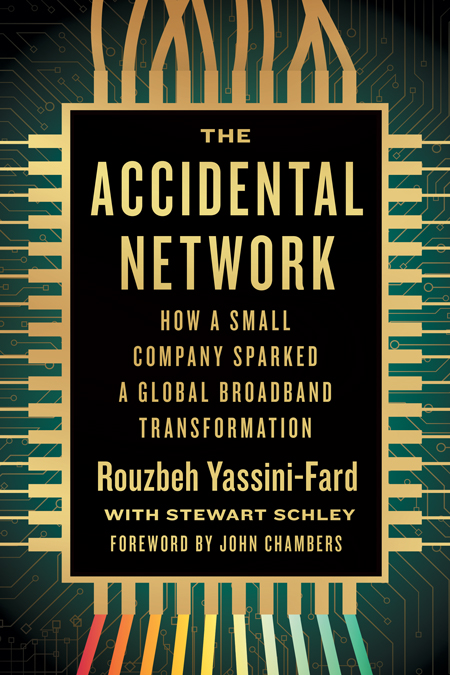
Rouzbeh Yassini-Fard, known as the “father of the cable modem,” is the author of The Accidental Network (West Virginia University Press, September 2025), a business memoir written with longtime industry journalist Stewart Schley.

Rouzbeh Yassini-Fard, Ph.D, is a technology entrepreneur and philanthropist whose Massachusetts-based organization, YAS Foundation, supports innovation and creativity addressing medical technology, telecommunications advocacy, educational scholarship and cultural collaboration. He is widely known as the “father of the cable modem,” tracing to the breakthrough achievements around high-speed data technology pioneered by LANcity, a company Yassini founded in 1988.
Images, Shutterstock