
Customer Experience is Not Measured. It Emerges.
Ask a broadband operator what caused a customer issue and the answer will often point to one domain: the access network, Wi-Fi, software, or the application. That instinct is understandable. Broadband operations have long relied on root cause analysis. When something goes wrong, operators isolate variables, examine evidence, identify the underlying cause, and take corrective action.
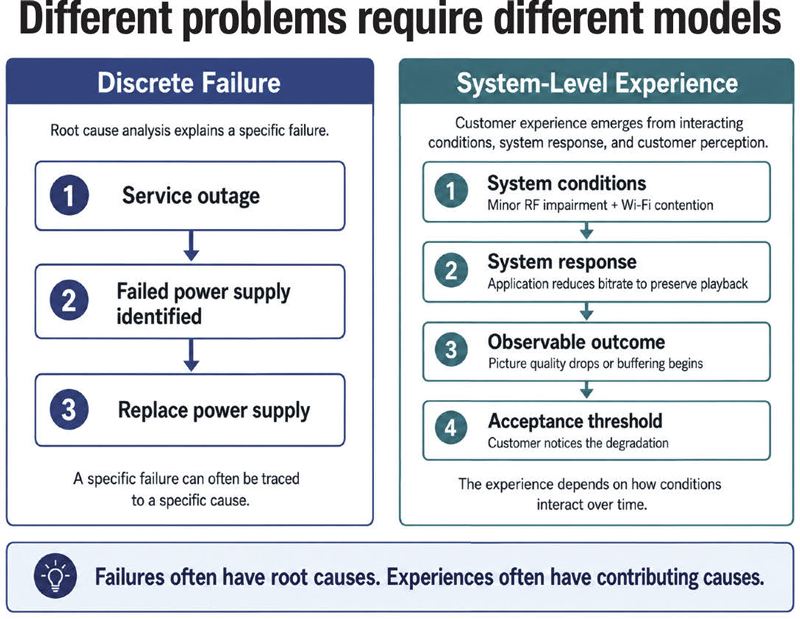
This approach remains essential. Fiber cuts, power supply failures, software defects, and many network impairments can often be traced to a specific event or condition. Root cause analysis helps assign ownership, focus remediation, and determine whether the issue has been resolved.
Customer experience, however, is a different kind of engineering problem. It is not always a failure that can be traced to one event. More often, it is the time-dependent response of a coupled system that includes the access network, the home network, the device, the application, and the customer. The experience is produced by how those parts interact, not by any one part in isolation.
Failures often have root causes. Experiences often have contributing causes.
That distinction matters because visibility does not automatically create a complete explanation. Measurements from different systems can all be accurate and still fail to explain why a customer noticed a problem at a particular moment.
The limits of a single explanation
Analytics have improved how impairments are detected, prioritized, and addressed. Yet the same technical condition can produce different customer outcomes depending on the state of the rest of the system.
A small decline in RF performance may be inconsequential when Wi-Fi capacity is abundant, and the application has room to adapt. The same decline may become noticeable when airtime is constrained, the device is less capable, or the application is operating close to its tolerance limit. The condition has not changed, but its effect has.
This is where a single-cause model begins to break down. A KPI may accurately describe one part of the environment without explaining the response of the entire system. An RF metric can reveal reduced signal quality. A Wi-Fi metric can show contention. An application metric can show bitrate reduction. Each observation is useful, but customer experience emerges from their combined effect over time.
The operational question is therefore not only, “Which metric crossed a threshold?” It is, “How did the system behave as conditions changed?”
When no single cause exists
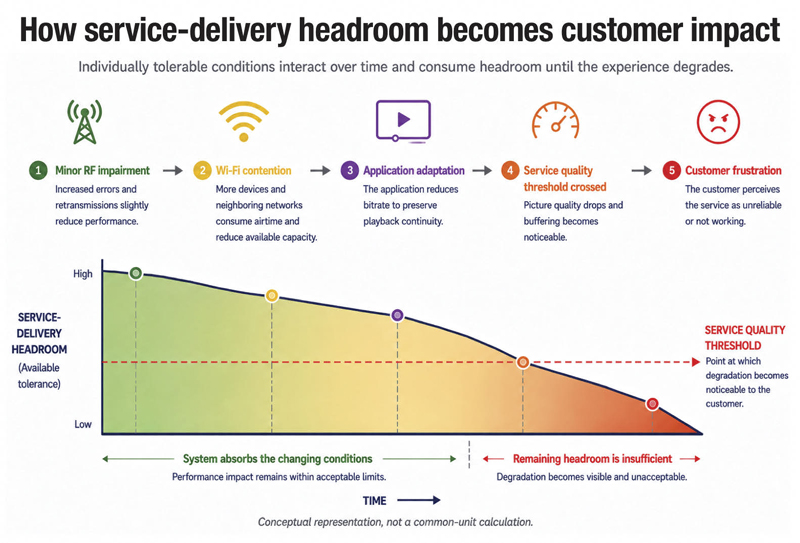
Consider a customer streaming a live sporting event. A minor RF impairment develops in the access network. It is not severe enough to trigger an outage, force modems offline, or produce an obvious service failure. Most operational thresholds remain within acceptable ranges. From an availability perspective, the service is still working.
At the same time, the customer’s Wi-Fi environment is experiencing elevated airtime contention. Several devices are active in the home, and neighboring networks are competing for spectrum. The Wi-Fi condition alone may not create a visible problem, but it reduces the headroom available to absorb additional degradation.
As conditions fluctuate, the streaming application adapts its bitrate to preserve playback. That adaptation is not another failure. It is a control response intended to maintain continuity. It preserves continuity but makes the changing system state visible through reduced picture quality. If conditions deteriorate further, buffering begins. The customer becomes frustrated and concludes that the broadband service is unreliable.
What was the root cause?
The RF impairment contributed. The Wi-Fi environment reduced available capacity. The application responded to preserve service. The customer’s expectations influenced whether the resulting quality was acceptable. Remove any one factor and the outcome may have been different.
No individual condition fully explains the experience because it was produced by the interaction and sequence of conditions. The issue was not simply that several metrics were poor. The system lost enough headroom, in a particular order, to cross the point at which degradation became noticeable.
From root cause to contribution analysis
Root cause analysis asks what failed. Experience analysis must reconstruct how the system behaved.
That requires more than placing several data sources on the same dashboard. The observations must be aligned to the same customer, service session, and time window. An RF event at 8:02 p.m. becomes more meaningful when evaluated alongside Wi-Fi contention, application adaptation, and a customer contact from the same period. Without that alignment, each event remains an isolated fact.
The relative contribution of each condition also depends on context. Not every threshold violation has the same effect, and the same condition does not carry the same significance in every environment. A modest increase in retransmissions may be harmless when the system has ample headroom, but consequential when another domain is already constrained.
Sequence matters as well. Conditions that exist at the same time are not necessarily equivalent to conditions that build on one another. A minor access-network impairment may reduce available margin. Wi-Fi contention may consume what remains. The application may adapt until it can no longer preserve acceptable playback. Understanding that progression reveals more than a static snapshot.
This is contribution analysis. It does not abandon causality or suggest that every factor matters equally. It seeks to determine which conditions were present, when they mattered, how they interacted, and what customer-visible outcome followed.
What connected intelligence requires
Connected intelligence should be understood as an operational capability, not a larger collection of metrics. Its value lies in connecting evidence across domains and using that evidence to explain system behavior.
The first requirement is observability at the level of the customer journey. Data from the access network, the home network, the device, and the application must be correlated in time and context. Operators must also understand interaction and available headroom: not only whether a condition existed, but whether the surrounding system could absorb it. Technical observations should then be connected to playback quality, responsiveness, stability, customer contact, or another observable result.
This changes remediation. If the streaming issue is assigned only to Wi-Fi, the operator may improve the home environment while leaving reduced access-network headroom untouched. If it is assigned only to RF, service may improve without addressing the condition that made the customer vulnerable to future degradation. A system-level explanation supports a response based on the combination of conditions rather than whichever metric first crossed a threshold.
Rethinking customer experience
The industry does not need to, and should not, abandon KPIs or root cause analysis. Both remain essential. The shift is to recognize where each approach is most useful.
Root cause analysis is highly effective when the problem is a discrete failure. Customer experience often requires a broader model because the outcome may be produced by several interacting conditions rather than one defective component. Treating every experience issue as a search for one cause can produce an answer that is operationally convenient but incomplete.
The operators that advance customer experience management will reconstruct the service journey as a system response. They will understand not only which conditions were present, but which ones mattered, when they mattered, and how they influenced one another.
Customer experience is not hidden inside a single measurement waiting to be discovered. It emerges from the behavior of the connected system.

Allen Maharaj,
Principal Access Network Designer,
Rogers Communications
Allen is a Principal Access Network Designer at Rogers Communications, specializing in access networks, DOCSIS®, and proactive network maintenance. With experience spanning design, installation, troubleshooting, and the operationalization of broadband technologies from the customer home to the core, he now focuses on evolving access network architectures to meet emerging demands. Allen’s work emphasizes practical strategies that balance customer experience with business realities such as cost, resources, and scalability. A frequent contributor to industry publications and conferences, he is recognized for combining deep technical expertise with pragmatic, forward-looking design.
images provided by Author (Generated using AI tools), Shutterstock.