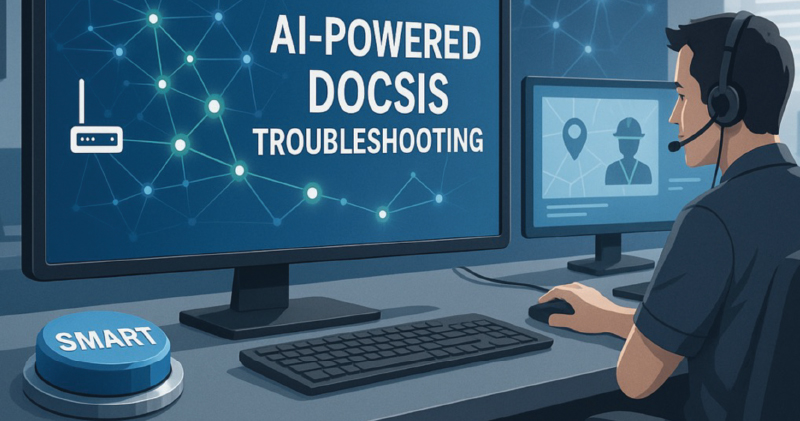
Accelerating DOCSIS® Troubleshooting for Cable Operators
Getting Smart with AI and PNM: The Operator’s New Edge
Let’s not sugarcoat it—HFC networks, for all their engineered resilience, are still full of difficult-to-uncover problems. Under the surface, impairments like amplitude variation, ingress, and corrosion sneak in or often explode in. These impairments negatively impact throughput and cause avoidable truck rolls. Lately, though, there’s a promising path forward: integrating artificial intelligence (AI) with proactive network maintenance (PNM). I’m discussing AI a lot these days in the context of DOCSIS because AI’s advancement is remarkable—and its ability to assist field technicians is equivalently transformative.
While still on the rollout, AI-driven PNM sits at the leading edge of troubleshooting—now taking form in three tightly coupled pillars: an AI Help Desk, a Smart Button with AI-Driven Insights, and new Agentic Process Automation for proactive, data-driven dispatching.
The walk from promise to production: AI PNM’s soft launch
I’ve ridden the DOCSIS evolution from basic telemetry dashboards to today’s early-stage agentic workflows. The difference? Now, we’re seeing AI move from passively parsing data in the background to actively driving the frontline—a shift that’s just getting off the ground. These modern PNM tools are built to transform raw modem data into rapid, actionable insights, but for most operators, this tech is in pilot phase, not full-scale deployment.
Pillar #1: AI help desk—guided help for everyone
The latest PNM platforms are rolling out a deceptively simple feature—an AI-driven Help Desk, embedded directly in the PNM application. With a single click, a field tech or customer service representative (CSR) gets real-time downstream, upstream, spectrum, registration data, and more for any cable modem, then receives a concise, plain-English checklist. The AI does the heavy lifting, converting piles of intimidating RF stats into clear next actions. This isn’t about replacing expertise—it’s about putting veteran-level triage into the hands of every technician.
Why does this change the game?
- Cuts triage time: No more bouncing between RxMER, power, equalization, and countless dashboards. AI serves only what matters.
- Bridges skill gaps: Junior members get guided, context-rich recommendations normally earned through years of experience.
Pillar #2: The smart button—real-time AI-driven insights
Click the Smart Button, and you’re met with a focused, real-time “medical chart” for that cable modem, powered by AI. Instead of a laundry list, you get practical, context-aware insights. For example:
- If FM ingress spikes in the 88 MHz to 108 MHz band, it recommends: “Inspect and fix drop and/or in-home wiring at subscriber location. Likely cause to be loose or improperly terminated connector or compromised shielding on drop/in-home wiring…”
- If DOCSIS authentication is failing, it flags: “Verify modem downstream receive levels are between -/+15 dBmV, upstream transmit levels are between 30 to 50 dBmV, RxMER >30 dB, uncorrectable codewords <5%. Inspect for loose or…”
- If RxMER anomalies are found: “RxMER degradation detected in upstream—potential plant ingress…”
The point: Urgent impairments become the primary focus, so agents and techs follow prioritized steps. This direct feed smooths out skill differences, enforces best practices, and minimizes subscriber downtime. The Help Desk utilizes SCTE and CableLabs technical documents, ensuring best recommendations and practices are followed.
Pillar #3: Agentic AI process—automated remediation and dispatch
The latest evolution that is under development goes further than just identifying problems. Here, AI analyzes ongoing telemetry to automatically identify the worst impairments across the cable plant footprint and auto-generate tickets and dispatch technicians, prioritizing the most impacted—or soon to be impacted—subscribers.
- AI monitors and ranks issues as they emerge, applying anomaly detection to send real-time alerts.
- Auto-generated tickets route to technicians with contextual evidence and remediation steps, ensuring the biggest problems get attention first.
- Proactive dispatch minimizes SLA breaches and maximizes plant reliability.
What are the upsides?
- Cuts mean time to repair: Automated actions mean many issues are handled before escalation.
- Objective prioritization: The most impactful problems take precedence, reducing the risk of human error or oversight.
- True plant visibility: Operators monitor health across the network—not just incident by incident.
Turning data into dollars—and future-proofing the plant
Though every operation is unique, early pilots tell a simple story: AI with PNM promises to cut truck rolls, boost first-pass fixes, and improve customer satisfaction. As agentic tools scale, dispatch rates drop and Net Promoter Score® (NPS) climbs, especially among bandwidth-savvy subscribers who notice seamless service.
Why AI with PNM excels—and what’s next
Let’s be real: DOCSIS plants mean data overload—thousands of endpoints (modems) streaming power samples, RxMER readings, and more. AI thrives here, flagging subtle patterns most humans would miss:
- Pattern matcher: Trains on classic and emerging impairment signatures.
- Uncovers the unknown: Finds multivariate issues hidden from basic analysis.
- Prescribes fixes: Transforms raw stats into actionable steps.
- Auto-escalates: Pushes systemic or chronic faults to higher tiers autonomously.
Every resolved incident improves the system—a feedback loop that sharpens both detection and repair.
The road ahead: Toward plant-wide agentic intelligence
Deployment won’t stop at the modem. AI will soon extend to:
- Auto-bundled plant maintenance: Scheduling fixes neighborhood-wide to minimize collective impact.
- Predictive node splits: Spotting congestion and triggering upgrades before customers notice. This is enhanced with the profile management application (PMA) and traffic analysis.
- Cross-layer insights: Correlating DOCSIS KPIs, Wi-Fi, and app experience into a holistic support model.
Final thoughts
PNM is leapfrogging the industry from firefighting to true predictive maintenance. The AI Help Desk, Smart Button, and now agentic auto-remediation and dispatch are the new cutting edge—turning mountains of data into prioritized, effective actions for every tier of support, making PNM both easier to use and more powerful. Real ROI arrives when “We know there’s a problem” becomes “It’s already fixed”—at machine speed and before customers call.

Brady Volpe
Mr. Volpe, the Chief Product Officer at OpenVault, brings over 30 years of experience in the broadband cable and telecommunications industry. As the founder of The Volpe Firm, Inc., and Nimble This (now OpenVault), he has been instrumental in product development and successful launches. Through his acclaimed blog, podcast, and livestream, he shares expertise in high-speed data, DOCSIS, PNM, HFC, ML, PMA, and more. Mr. Volpe has an unwavering commitment to broadband innovation.
Figures provided by author